

Understanding Tablet Dosage Forms
Tablet dosage forms are a prevalent type of pharmaceutical formulation characterized by their solid-state, often intended for oral administration. They typically comprise a mixture of active pharmaceutical ingredients (APIs) and excipients, which are inert substances that serve various functional roles during the manufacturing process as well as in the final product. The significance of tablet dosage forms in the pharmaceutical industry lies in their widespread use, ease of administration, and potential cost-effectiveness in mass production.
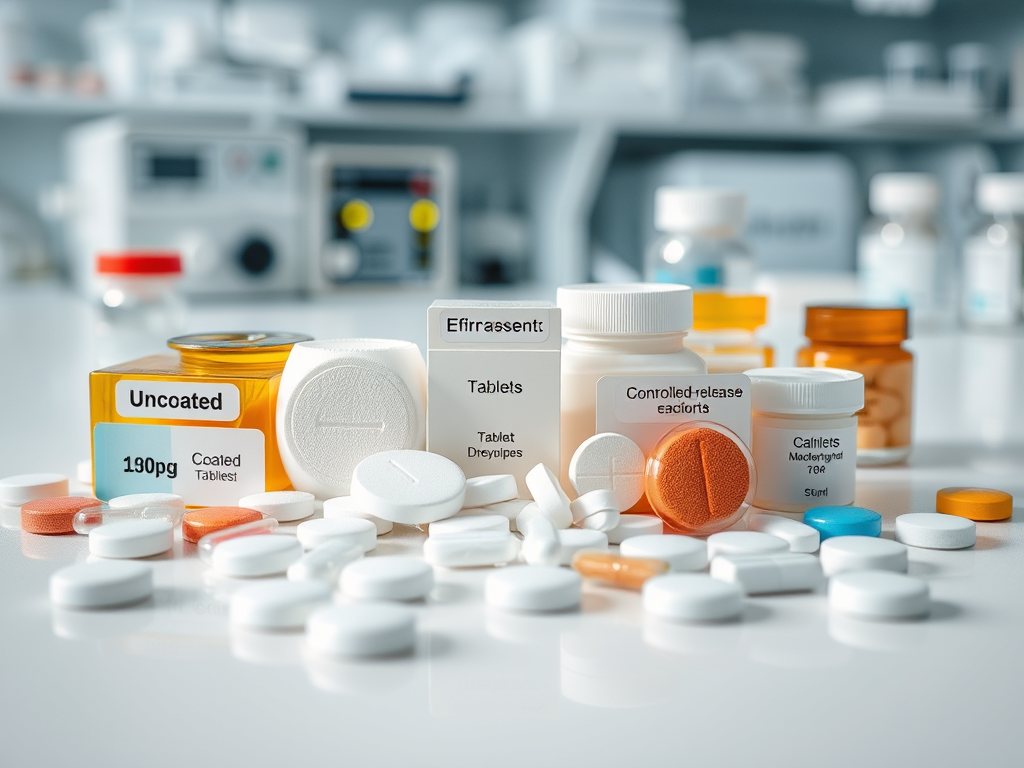
Tablets can be classified into various types, including coated, uncoated, effervescent, and controlled-release tablets, each designed to meet specific therapeutic needs. The basic components of a tablet are crucial for its performance; the active pharmaceutical ingredient is responsible for the intended therapeutic effect, while excipients contribute to the tablet’s overall stability, bioavailability, and patient compliance. Common excipients may include binders, fillers, disintegrants, and lubricants, each serving a distinct purpose during tablet formulation.
The advantages of using tablet dosage forms over alternative routes of administration, such as injections or liquid preparations, are notable. Tablets offer convenience for the patient in terms of dosing and portability. Furthermore, they typically demonstrate favorable storage stability, reducing the risk of spoilage over time. Precise formulation is essential in the development of tablet dosage forms, as it ensures the correct dosage of the API is delivered effectively to the patient, thereby enhancing therapeutic efficacy. This attention to detail in the formulation process guarantees that tablets meet stringent quality standards, thereby reinforcing their critical role in modern pharmaceuticals. In summary, the understanding of tablet dosage forms is fundamental for pharmaceutical professionals involved in drug development and manufacturing. These dosage forms represent a significant aspect of medication delivery, embodying both convenience and advanced pharmaceutical technology.
Key Steps in Tablet Formulation Process
The formulation of tablet dosage forms is a multidimensional process that requires meticulous planning and execution. One of the preliminary steps is conducting pre-formulation studies, which assess the physicochemical properties of the active pharmaceutical ingredient (API). These studies focus on solubility, stability, and biocompatibility—all of which are critical to ensuring optimal drug delivery and efficacy. Understanding these characteristics influences the choice of excipients, such as binders, fillers, and lubricants, among others, that will be utilized in the formulation.
Once the excipients are selected, the next phase involves blending. During this stage, the API is mixed with the selected excipients to ensure a uniform distribution in the tablet. The blending process largely depends on the flow properties and particle size of the components, which are crucial for achieving a consistent powder mass. Ineffective blending can lead to variations in tablet dosage, affecting the therapeutic efficacy.
Granulation follows, where the blended material is transformed into granules. This is a vital step as it enhances the flowability and compressibility of the powder. Granulation can be performed via dry or wet methods, depending on the specific requirements of the formulation. The prepared granules are then subjected to compression, a process where they are compacted into tablet form using a tablet press. The compression forces used need to be optimized to avoid issues such as lamination or capping, which could compromise tablet integrity.
The final stage often involves coating, which serves multiple purposes, including taste masking, protection from environmental factors, and controlled release of the API. Advances in coating technology have introduced new materials and techniques that enhance tablet performance. The integration of modern technologies throughout these processes underscores the importance of innovation in ensuring the efficiency and quality of tablet dosage forms in pharmaceutical industries.
Quality Control and Testing of Tablet Dosage Forms
Quality control is a fundamental component in the formulation and production of tablet dosage forms within pharmaceutical industries. Ensuring the safety and efficacy of these products requires stringent testing protocols that adhere to established regulatory requirements. The quality attributes of tablet formulations must be meticulously monitored to guarantee that they meet predefined standards.
One of the critical quality attributes is drug content uniformity, which verifies that each tablet contains a consistent quantity of the active pharmaceutical ingredient (API). This is essential not only for therapeutic effectiveness but also for patient safety. Variations in API content can lead to subtherapeutic dosing or potential toxicity, thus underscoring the importance of this parameter.
Other significant quality measures include tablet hardness, friability, disintegration, and dissolution rates. Tablet hardness, for instance, influences the mechanical stability during handling and transport, while friability assessments determine the tablet’s ability to withstand stress without breaking apart. Disintegration tests evaluate how quickly a tablet breaks down in gastrointestinal conditions, and dissolution testing measures the rate at which the API is released into solution, an essential factor for pharmacokinetics.
Adhering to international regulatory standards, such as those established by the FDA or the European Medicines Agency, is imperative in the realm of tablet testing. Compliance ensures that tablet formulations meet safety, quality, and efficacy standards before reaching the market. Advanced analytical techniques, including High-Performance Liquid Chromatography (HPLC) and spectroscopic methods, facilitate these testing processes. Such methods enhance the precision of quality control assessments, ensuring that results are accurate and reproducible.
Ultimately, robust quality control in the production of tablet dosage forms is vital for maintaining product integrity and compliance with regulatory expectations. This not only protects public health but also fosters trust in pharmaceutical products.
Challenges and Innovations in Tablet Formulation
The formulation of tablet dosage forms presents numerous challenges that the pharmaceutical industry must navigate. One of the primary difficulties lies in the complex nature of drug substances, which can vary significantly in their physicochemical properties. These inconsistencies can impact the solubility, bioavailability, and stability of the drugs, ultimately affecting their therapeutic efficacy. As pharmaceutical scientists work to optimize tablet formulations, they must address these variations to ensure consistent product performance.
Another critical challenge is the need for customized release profiles. As personalized medicine gains traction, the demand for tablets that can deliver drugs at specific rates or times has increased. This complexity requires innovative approaches in formulation design. For instance, matrix systems, coating technologies, and osmotic pumps are increasingly employed to achieve the desired control over drug release. These methods aim to enhance patient adherence by ensuring optimal therapeutic outcomes through tailored delivery mechanisms.
Stability concerns also play a vital role in the formulation process. Tablets must maintain their integrity and potency over time, necessitating rigorous stability testing and the selection of appropriate excipients. The industry faces pressures from regulatory bodies to comply with stringent guidelines, which can complicate the development of stable formulations. To overcome such challenges, researchers are exploring novel excipients that can improve not only stability but also the overall performance of tablet dosage forms.
Recent innovations are paving the way for advancements in tablet formulations. Technologies like 3D printing have emerged, providing opportunities for the creation of complex geometries that may not be achievable through traditional methods. Furthermore, these advancements facilitate the customization of tablets to cater to individual patient needs. The ongoing evolution in tablet formulation methodologies reflects the pharmaceutical industry’s commitment to meeting the rapidly changing healthcare landscape through innovative formulation strategies.